Internal blind spots threaten accountancy growth as firms fail to hit revenue targets

Dayshape

Accountancy practice management software has come a long way. Today, features like automated billing and reconciliations are easily integrated into the day-to-day practice workflow of Wolters Kluwer Tax & Accounting UK customers.

Our employees work side by side with our customers to create and manage these solutions – driven by a deep understanding of their needs and addressing the rapid changes in their environment.

However, it’s often hard to look beyond improving performance in day-to-day operations. Amid Brexit, the COVID-19 pandemic and other disruptions, accountancy practices and their clients are dealing with an unpredictable economic landscape. Future business planning can appear daunting.

However, technology can support accountancy practices (and their clients) in making informed business decisions, and planning for the future. In the first part of our Accountancy Practice Management for Future-Fit Growth series, we’ll explore how they can use technology to define and easily track Key Performance Indicators (KPIs). Doing so gives practices closer control of performance tracking, and deeper insights that will inform strategic growth plans.

Saving Time

For several decades, business technology platforms have enabled practices to track performance metrics that they have customised. This highlights areas that qualify for improvement and underpins strategic planning.

Contemporary technology, such as CCH KPI Monitoring, makes setting up KPIs faster and easier for accountancy practices than ever before. This is vital today. The current business landscape demands that firms assess and amend KPIs more frequently, based on fresh market variables. KPIs such as client retention rate and business time-to-recovery have become increasingly prominent performance indicators in the past year. If clunky technology makes KPI management difficult, practices have less time and insight to plan future growth.

Reducing Risk
CCH KPI Monitoring makes it far easier to track KPIs and report on them. This is fundamental in minimising risk. For example, if a KPI is set to track and escalate debt filtered by overdue dates, the ability to easily set alerts and automatically generate reports is critical to practice performance management.

Some practices are manually running monthly reports to measure KPIs. Others are running real-time reporting engines, a key feature of CCH KPI Monitoring. This latter solution allows practices to review essential data at any time – covering both performance management and compliance requirements. They can do so remotely or on-premise.

This means that firms can assess issues before they become problems, and thus act proactively. Real-time reporting is a true asset in building a future-fit practice.

The Proof is in the Practice
A number of Wolters Kluwer customers have been using CCH KPI Monitoring for several years now. Our customers look to us when they need to be right. Ryecroft Glenton has successfully integrated CCH KPI Monitoring with its own system. This consolidates information from several sources, including CCH Central and CCH Practice Management.

“We can use the year end date to trigger a sequence of reminders. Have we asked for the books? Have they been received? If a request to a client has been outstanding for a certain period, the partner will receive an alert via email. For limited companies, we can monitor the corporation tax and Companies House filing deadlines – as well as the different deadlines for pension schemes”

– Ian Smith, partner at Ryecroft Glenton

Corporate events agency who benefited from greener graphics initiative

“Apogee are not just aprinting company, theyconsult with us and go onto deliver a full end to endservice from concept toinstallation. They go aboveand beyond and we lookforward to continuing ourjourney with them”
Corporate events agency who benefited from greener graphics initiative

“Apogee are not just aprinting company, theyconsult with us and go onto deliver a full end to endservice from concept toinstallation. They go aboveand beyond and we lookforward to continuing ourjourney with them”

Corporate events agency who benefited from greener graphics initiative

“Apogee are not just aprinting company, theyconsult with us and go onto deliver a full end to endservice from concept toinstallation. They go aboveand beyond and we lookforward to continuing ourjourney with them”

Corporate events agency who benefited from greener graphics initiative

“Apogee are not just aprinting company, theyconsult with us and go onto deliver a full end to endservice from concept toinstallation. They go aboveand beyond and we lookforward to continuing ourjourney with them”

Professional services firms, including those in accountancy, are leaving growth on the table. Our latest report, Inside the leadership growth agenda (using survey results from 400 senior leaders across mid-to-large professional services firms in the UK and US) reveals that one of the greatest threats to growth isn’t market volatility or client demand, but internal inefficiencies that can be controlled and fixed.

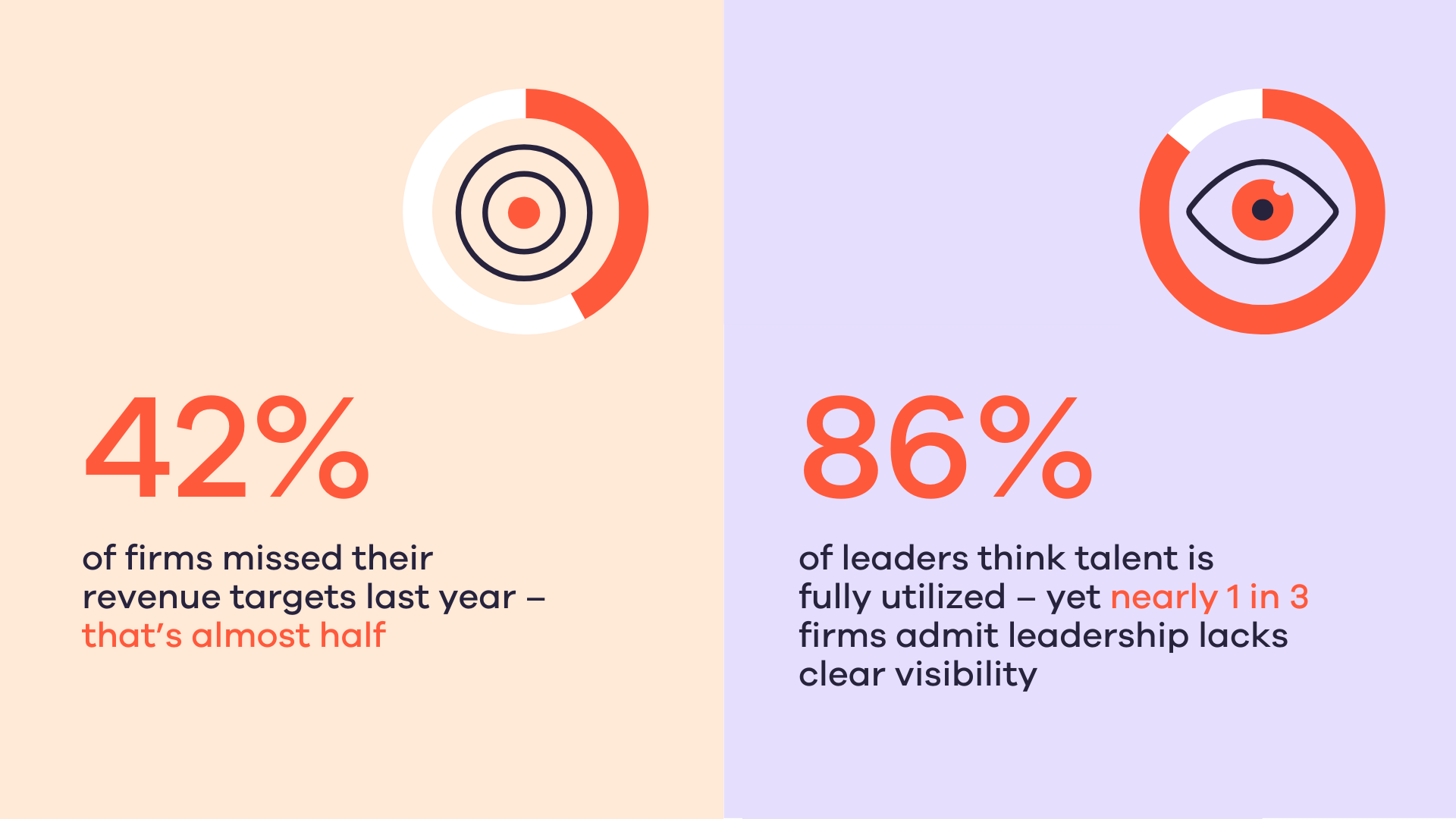
Our survey found that 42% of firms failed to hit their revenue targets last year. While external pressures such as economic uncertainty and competition played a role, internal blind spots were just as disruptive. Inaccurate forecasting was cited by 30% of firms while 27% blamed capacity constraints, and project overruns/write offs were an issue for 14% of firms. The result is growth slipping quietly through the cracks.

Only one in four (25%) leaders said they were confident in their firm’s operational discipline and ability to plan long term. That lack of visibility has real consequences. Without reliable data on capacity, profitability, or workload balance, firms risk overcommitting resources, misjudging which clients or services deliver profit, and designing growth strategies on incomplete information.

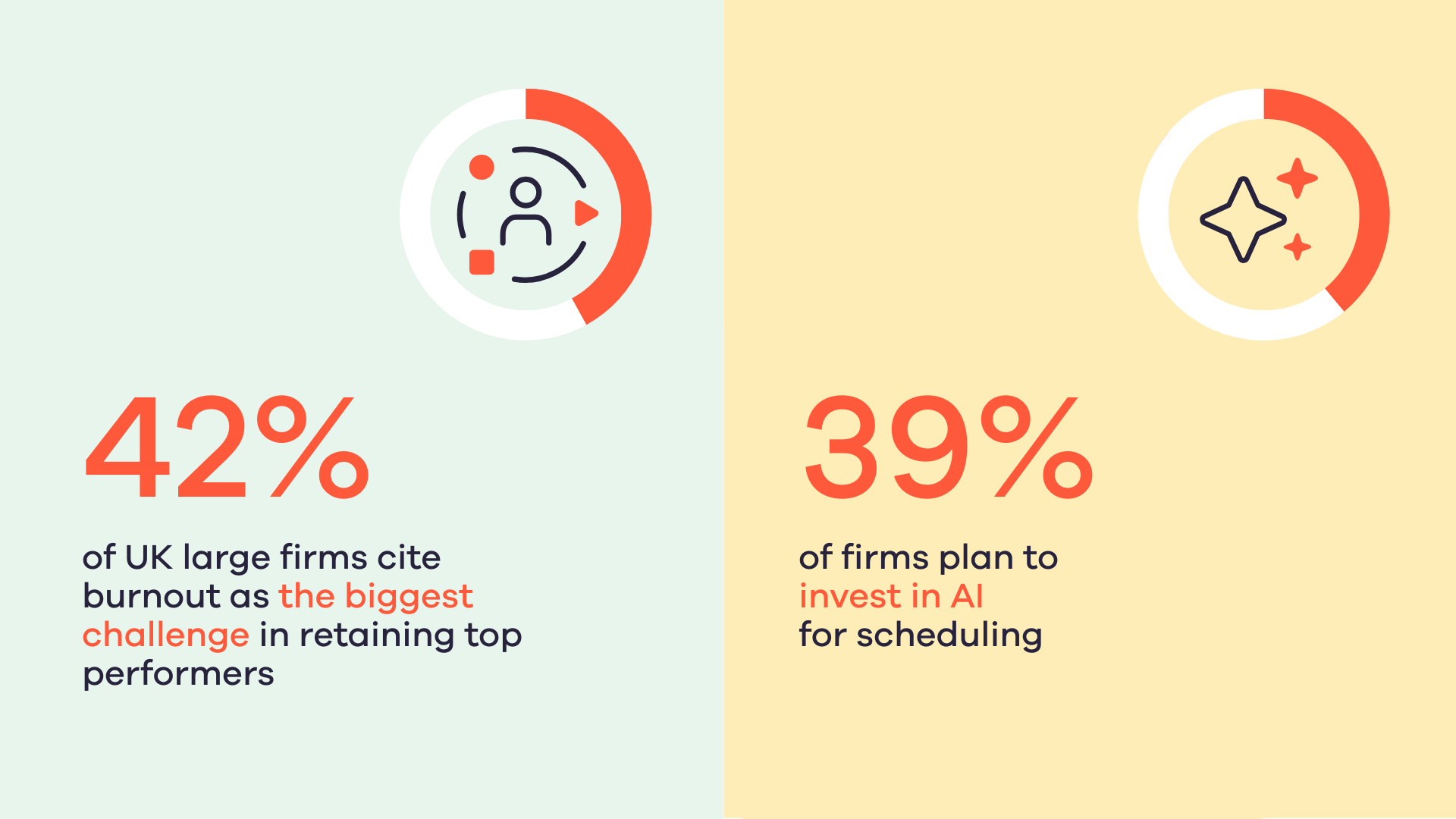
The visibility gap runs deeper than revenue planning. 86% of leaders believe their people are utilised to their full potential, yet almost a third (31%) of leaders say they don’t have a clear view of team-level capacity. This “utilisation mirage” masks hidden inefficiencies, project overruns, and burnout in large firms (42%). At the same time, lack of fairness and autonomy are emerging as retention risks, with 24% of leaders citing unfair workload distribution and 29% of leaders pointing to poor management and lack of autonomy.  

Technology offers hope but progress remains uneven, and firms are prioritising the use of technology to solve this issue. While 32% plan to invest in AI for scheduling and capacity modelling, many are held back by poor data quality (34%) and integration challenges (32%). Despite this, technology tops the leadership agenda for 61% of firms, signalling growth recognition that operational efficiency and visibility are now strategic boardroom priorities.

Matt Cockett, CEO of Dayshape, said: “Professional services firms are leaving growth on the table. The problem isn’t a lack of opportunity. It’s a lack of alignment between people, planning, and performance. When internal systems don’t talk to each other and leaders can’t get the crucial insights they need, growth stalls – no matter how strong the market looks from the outside. Every firm has blind spots, but shining a light on them brings opportunities. The leaders who act on them will capture growth others leave behind.”

The report, Inside the leadership growth agenda, highlights how internal planning weaknesses are as damaging as external pressures. Firms that close these gaps can turn ambition into performance through real-time forecasting, joined-up data, and predictive resource management.  

Cockett added: “In what is an increasingly pressured and volatile market, predictability is a company’s (and its growth prospects’) greatest ally. Firms that invest in a future looking view of their resourcing and operational efficiency will not only protect revenue but build the confidence and resilience to grow, even when the market shifts.”

Download the report.

Dec 2025

Shaping a Culture That Supports Smarter Information Governance

Many organisations invest significant time and effort developing information governance policies. They run training, communicate expectations, and secure leadership support. On paper, everything looks ready for success.

Data security, scenario planning, and sleeping well at night

Advancetrack outlines some of the first steps that an accountancy practice should take to manage internal IT security. We also chat to CTO Ian Gregory about Advancetrack’s approach to mitigating IT risk.

From Data Bog to Capacity Lake: Integrating Systems for AI-Ready Scheduling

Most firms are still somewhere on their cloud adoption journey, but whether fully on-prem, cloud, or a blend - key data about people, clients, and projects are not fully connected. This presents a missed opportunity in not using this data to improve how the firm runs. Not the cliche of “actionable insights” from reporting, but using the data operationally to deliver more work, with more profit.

Finding Truth in Time: Inside CloudCapcha’s Vision for High-Performing Accounting Firms

CloudCapcha is inviting accounting leaders to rethink not just how time is captured, but what that data can reveal about performance, profitability and firm-wide efficiency.

How to Change the Role of Technology to a Profit Centre in our Firms

Often our work involves looking at the structure of technology functions within firms, and so for this article I thought I’d share our current thinking on optimal arrangements. The example I am using is split-out for larger firms, but for smaller firms the approach remains valid, just with some roles collapsed to fewer people.

Cloud cost mistakes and how to avoid them!

Cloud costs have moved beyond IT and are now a board-level issue. As firms move more workloads to the cloud and adopt AI-driven services, spending is rising fast and becoming harder to predict.