From Data Bog to Capacity Lake: Integrating Systems for AI-Ready Scheduling

Accountancy practice management software has come a long way. Today, features like automated billing and reconciliations are easily integrated into the day-to-day practice workflow of Wolters Kluwer Tax & Accounting UK customers.

Our employees work side by side with our customers to create and manage these solutions – driven by a deep understanding of their needs and addressing the rapid changes in their environment.

However, it’s often hard to look beyond improving performance in day-to-day operations. Amid Brexit, the COVID-19 pandemic and other disruptions, accountancy practices and their clients are dealing with an unpredictable economic landscape. Future business planning can appear daunting.

However, technology can support accountancy practices (and their clients) in making informed business decisions, and planning for the future. In the first part of our Accountancy Practice Management for Future-Fit Growth series, we’ll explore how they can use technology to define and easily track Key Performance Indicators (KPIs). Doing so gives practices closer control of performance tracking, and deeper insights that will inform strategic growth plans.

Saving Time

For several decades, business technology platforms have enabled practices to track performance metrics that they have customised. This highlights areas that qualify for improvement and underpins strategic planning.

Contemporary technology, such as CCH KPI Monitoring, makes setting up KPIs faster and easier for accountancy practices than ever before. This is vital today. The current business landscape demands that firms assess and amend KPIs more frequently, based on fresh market variables. KPIs such as client retention rate and business time-to-recovery have become increasingly prominent performance indicators in the past year. If clunky technology makes KPI management difficult, practices have less time and insight to plan future growth.

Reducing Risk
CCH KPI Monitoring makes it far easier to track KPIs and report on them. This is fundamental in minimising risk. For example, if a KPI is set to track and escalate debt filtered by overdue dates, the ability to easily set alerts and automatically generate reports is critical to practice performance management.

Some practices are manually running monthly reports to measure KPIs. Others are running real-time reporting engines, a key feature of CCH KPI Monitoring. This latter solution allows practices to review essential data at any time – covering both performance management and compliance requirements. They can do so remotely or on-premise.

This means that firms can assess issues before they become problems, and thus act proactively. Real-time reporting is a true asset in building a future-fit practice.

The Proof is in the Practice
A number of Wolters Kluwer customers have been using CCH KPI Monitoring for several years now. Our customers look to us when they need to be right. Ryecroft Glenton has successfully integrated CCH KPI Monitoring with its own system. This consolidates information from several sources, including CCH Central and CCH Practice Management.

“We can use the year end date to trigger a sequence of reminders. Have we asked for the books? Have they been received? If a request to a client has been outstanding for a certain period, the partner will receive an alert via email. For limited companies, we can monitor the corporation tax and Companies House filing deadlines – as well as the different deadlines for pension schemes”

– Ian Smith, partner at Ryecroft Glenton

Corporate events agency who benefited from greener graphics initiative

“Apogee are not just aprinting company, theyconsult with us and go onto deliver a full end to endservice from concept toinstallation. They go aboveand beyond and we lookforward to continuing ourjourney with them”

Corporate events agency who benefited from greener graphics initiative

“Apogee are not just aprinting company, theyconsult with us and go onto deliver a full end to endservice from concept toinstallation. They go aboveand beyond and we lookforward to continuing ourjourney with them”

Corporate events agency who benefited from greener graphics initiative

“Apogee are not just aprinting company, theyconsult with us and go onto deliver a full end to endservice from concept toinstallation. They go aboveand beyond and we lookforward to continuing ourjourney with them”
Corporate events agency who benefited from greener graphics initiative

“Apogee are not just aprinting company, theyconsult with us and go onto deliver a full end to endservice from concept toinstallation. They go aboveand beyond and we lookforward to continuing ourjourney with them”

Most firms are still somewhere on their cloud adoption journey, but whether fully on-prem, cloud, or a blend - key data about people, clients, and projects are not fully connected. This presents a missed opportunity in not using this data to improve how the firm runs. Not the cliche of “actionable insights” from reporting, but using the data operationally to deliver more work, with more profit.

Tying those data sources into a coherent view of the firm’s ability to deliver – a “capacity lake” if you will.

Why your data feels like a bog

Murky, opaque, dirty... terrifying?

In an accounting firm, your people and project data typically lives across:

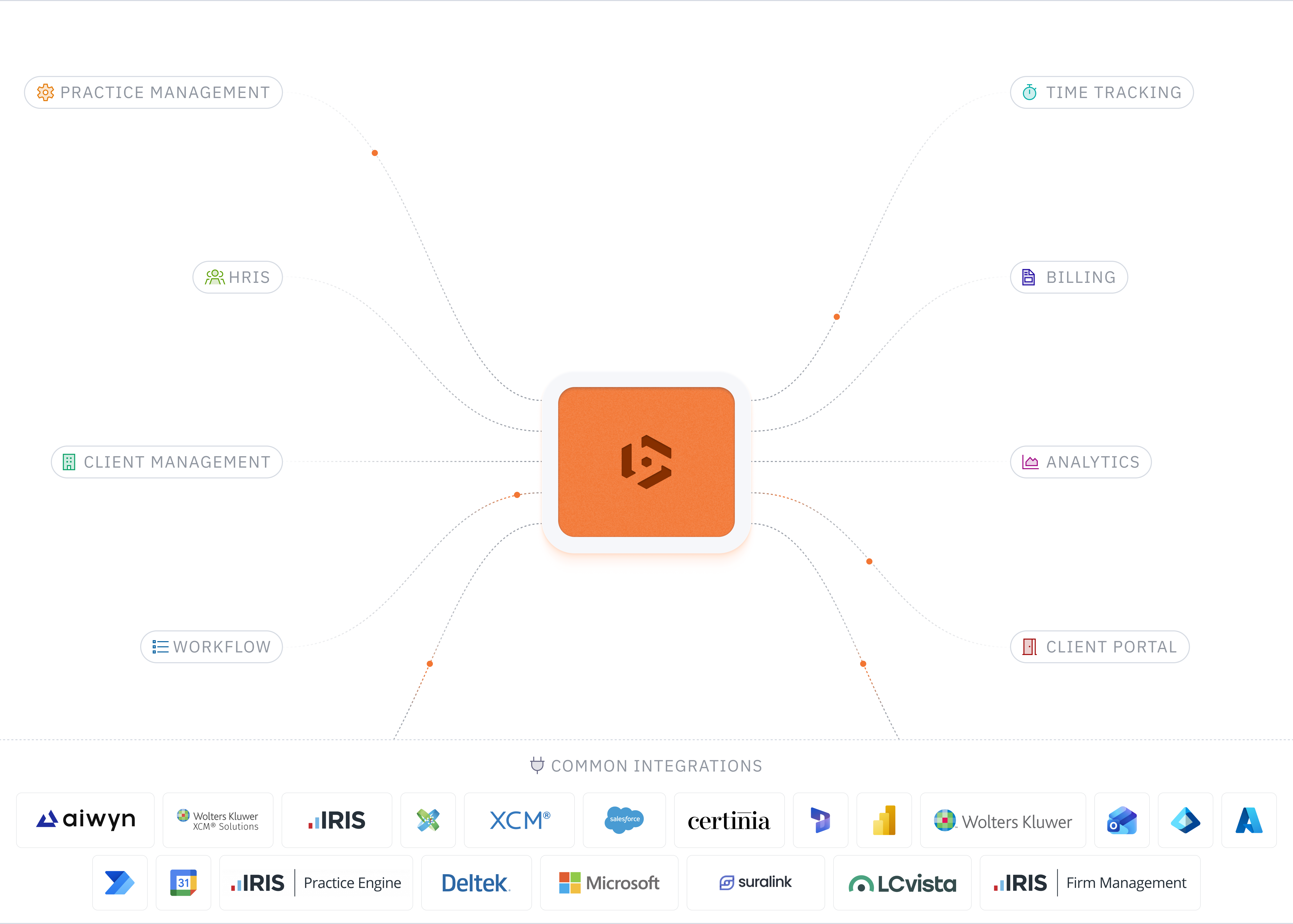
Practice / engagement management (IRIS, CCH, etc.): clients, engagements, budgets, job codes, service lines.
Finance & ERP (Dynamics, Certinia): billing, WIP, realisation
CRM (Salesforce): pipeline, upcoming engagements, clients, budgets
HR & talent systems (Workday, LCVista): grades, teams, offices, working patterns, skills, rates, time-off
Timekeeping (Laurel): actual hours, realization
– Plus a long tail of spreadsheets...

The spread will be tighter if you have only a few solutions, but the rise of best-of-breed cloud software means tech stacks and data sources are rapidly increasing for accounting firms.

Integrations may exist between these tools, but usually serve a specific purpose such as triggering workflows between solutions, or reconciling the source of truth of a record type that is used in multiple systems. They can’t answer questions such as:

“Where will we run out of senior audit capacity in Q3?”
– “Which individuals are at risk of being overbooked on fixed-fee work?”
– “Where could we move work between offices or service lines without impacting quality?”

Even if you have a data lake, IT and analysts will dread these questions coming from leadership if it means wading into a hard to navigate bog of data for one-off extracts and Power BI models.

Why good, integrated capacity data is vital for AI applications

The Resource Management Institute (RMI) is blunt about this: data quality and governance are the biggest challenges to effective resource management. Disconnected, poor data impacts capacity planning and work allocation decisions even when doing it manually. It’s critical if you want to use AI scheduling.

In recent RMI research, resource management leaders called out “lack of quality data” as their largest governance issue and stressed the need for data on the “health of the data” itself.

If AI is going to recommend who should work on which engagement, when, it needs:

– Reliable information about people (skills, grade, availability, rates).
– Real-time engagement context (budgets, fees, deadlines, margin targets).
– Timekeeping and actuals for pivoting live engagement schedules

Otherwise, you’re just automating the “garbage in, garbage out” problem RMI warns about: the AI will confidently optimise based on bad or incomplete data. (Resource Management Institute)

Whether the data is coming straight from SaaS systems or via a data lake in Azure/AWS/GCP, the goal is the same: a consistent, governed model that treats capacity data as an asset.

Where Beeye fits in your practice management

Beeye isn’t trying to be your data lake. Rather, it integrates with your other systems (including a data lake if you’ve built one) to centralise all relevant information in a single place that engagement managers and operations teams then use to see capacity, allocate work, and manage conflicts in real time. Partners can see the firm-wide utilization, realisation, capacity and profit reports they need without putting demands on your team for data pulls.

– Allocate work based on availability, skills, budgets and margin targets.
– See planned vs scheduled vs actual hours in one place, early enough to change course.
– Export the same structured model back into your analytics layer (often Power BI)


For firms without a data lake, Beeye helps you bridge the gaps between disconnected systems and finally act on the data you already own. For firms with a data lake, Beeye becomes the operational front-end that turns that curated data into concrete decisions about who does what, when – and what that means for profitability.

Either way, integrating these sources into a coherent capacity picture is no longer a “nice to have”. It’s the prerequisite for both better manual scheduling and any serious attempt at AI-driven resource management.

Learn more about what Beeye resource management can do for your firm: https://www.mybeeye.com/en/best-resource-management-for-full-accounting-firm-scheduling?utm_source=aituk&utm_medium=email&utm_campaign=aituk_news_q4

Dec 2025

Shaping a Culture That Supports Smarter Information Governance

Many organisations invest significant time and effort developing information governance policies. They run training, communicate expectations, and secure leadership support. On paper, everything looks ready for success.

Data security, scenario planning, and sleeping well at night

Advancetrack outlines some of the first steps that an accountancy practice should take to manage internal IT security. We also chat to CTO Ian Gregory about Advancetrack’s approach to mitigating IT risk.

Finding Truth in Time: Inside CloudCapcha’s Vision for High-Performing Accounting Firms

CloudCapcha is inviting accounting leaders to rethink not just how time is captured, but what that data can reveal about performance, profitability and firm-wide efficiency.

Internal blind spots threaten accountancy growth as firms fail to hit revenue targets

Professional services firms, including those in accountancy, are leaving growth on the table. Our latest report, Inside the leadership growth agenda reveals that one of the greatest threats to growth isn’t market volatility or client demand, but internal inefficiencies that can be controlled and fixed.

How to Change the Role of Technology to a Profit Centre in our Firms

Often our work involves looking at the structure of technology functions within firms, and so for this article I thought I’d share our current thinking on optimal arrangements. The example I am using is split-out for larger firms, but for smaller firms the approach remains valid, just with some roles collapsed to fewer people.

Cloud cost mistakes and how to avoid them!

Cloud costs have moved beyond IT and are now a board-level issue. As firms move more workloads to the cloud and adopt AI-driven services, spending is rising fast and becoming harder to predict.