An interview with CloudCapcha CEO, Phil Lowe


Accountancy practice management software has come a long way. Today, features like automated billing and reconciliations are easily integrated into the day-to-day practice workflow of Wolters Kluwer Tax & Accounting UK customers.
Our employees work side by side with our customers to create and manage these solutions – driven by a deep understanding of their needs and addressing the rapid changes in their environment.
However, it’s often hard to look beyond improving performance in day-to-day operations. Amid Brexit, the COVID-19 pandemic and other disruptions, accountancy practices and their clients are dealing with an unpredictable economic landscape. Future business planning can appear daunting.
However, technology can support accountancy practices (and their clients) in making informed business decisions, and planning for the future. In the first part of our Accountancy Practice Management for Future-Fit Growth series, we’ll explore how they can use technology to define and easily track Key Performance Indicators (KPIs). Doing so gives practices closer control of performance tracking, and deeper insights that will inform strategic growth plans.
Saving Time
For several decades, business technology platforms have enabled practices to track performance metrics that they have customised. This highlights areas that qualify for improvement and underpins strategic planning.
Contemporary technology, such as CCH KPI Monitoring, makes setting up KPIs faster and easier for accountancy practices than ever before. This is vital today. The current business landscape demands that firms assess and amend KPIs more frequently, based on fresh market variables. KPIs such as client retention rate and business time-to-recovery have become increasingly prominent performance indicators in the past year. If clunky technology makes KPI management difficult, practices have less time and insight to plan future growth.
.jpg)
Reducing Risk
CCH KPI Monitoring makes it far easier to track KPIs and report on them. This is fundamental in minimising risk. For example, if a KPI is set to track and escalate debt filtered by overdue dates, the ability to easily set alerts and automatically generate reports is critical to practice performance management.
Some practices are manually running monthly reports to measure KPIs. Others are running real-time reporting engines, a key feature of CCH KPI Monitoring. This latter solution allows practices to review essential data at any time – covering both performance management and compliance requirements. They can do so remotely or on-premise.
This means that firms can assess issues before they become problems, and thus act proactively. Real-time reporting is a true asset in building a future-fit practice.
The Proof is in the Practice
A number of Wolters Kluwer customers have been using CCH KPI Monitoring for several years now. Our customers look to us when they need to be right. Ryecroft Glenton has successfully integrated CCH KPI Monitoring with its own system. This consolidates information from several sources, including CCH Central and CCH Practice Management.
“We can use the year end date to trigger a sequence of reminders. Have we asked for the books? Have they been received? If a request to a client has been outstanding for a certain period, the partner will receive an alert via email. For limited companies, we can monitor the corporation tax and Companies House filing deadlines – as well as the different deadlines for pension schemes”
– Ian Smith, partner at Ryecroft Glenton
.jpg)
“Apogee are not just aprinting company, theyconsult with us and go onto deliver a full end to endservice from concept toinstallation. They go aboveand beyond and we lookforward to continuing ourjourney with them”


“Apogee are not just aprinting company, theyconsult with us and go onto deliver a full end to endservice from concept toinstallation. They go aboveand beyond and we lookforward to continuing ourjourney with them”
CloudCapcha is inviting accounting leaders to rethink not just how time is captured, but what that data can reveal about performance, profitability and firm-wide efficiency. Rather than rebuild a traditional practice management system in a browser, CloudCapcha focused on solving a single, structural challenge: time—reimagined as an intelligent layer that integrates across the entire digital ecosystem of a modern accounting firm.
It’s a philosophy shaped for today’s reality, where technology stacks shift, teams collaborate inside Microsoft Teams, and leaders need visibility based on truth, not reconstruction.
We sat down with CEO Phil Lowe to explore the ideas behind CloudCapcha’s approach.
Putting Time Where Accountants Actually Work
Q: You’ve said CloudCapcha rethought time recording from the ground up. What does that mean in practice?
Phil Lowe: A lot of accounting firms still rely on systems that feel like digitised versions of paper processes: a time screen here, a WIP & Billing ledger screen there, and a ledger at the back. These systems require accountants to step out of their workflow just to track what they were doing.
But where do accountants actually live digitally today? A decade ago it was Outlook. Now, overwhelmingly, it’s Microsoft Teams. That’s where client queries, collaboration, review cycles, messaging and meetings all take place.
So instead of rebuilding a separate timesheet, we built WorkCapcha as a native Teams application. Time becomes something that fits naturally into the accountant’s day. Whether they’re responding to a client message, reviewing a file or joining a meeting, WorkCapcha is already there—no extra windows, no extra login, no extra app. And because it runs inside Teams, firms don’t need a separate rollout or mobile deployment. If you have Teams, you have WorkCapcha.
From Timesheet to Truth: The “DayBook”
Q: Many tools claim to offer automatic time capture. What makes your approach different?
Phil: Most tools only capture a narrow slice of the working day. They may pick up emails or time in Word, but miss browsing in cloud accounting platforms, client portal work, research tools, audit systems or legacy apps.
The result is partial truth - and partial truth still forces accountants to fill in gaps from memory.
We took a different approach. Our “DayBook” is a digital memory of the accountant’s entire working day, capturing activity across:
– Microsoft Teams, Outlook, calendars and meetings
– Browser-based accounting suites, workflow tools and portals
– Desktop and legacy systems, even those running through Citrix or virtual desktops
From there, we use machine learning to propose accurate entries mapped to the right client, engagement and activity code. The accountant remains in control—they can edit or add entries at any time—but they’re not starting or ending the day staring at a blank timesheet.
Agnostic by Design: Integration Without Lock-In
Q: You emphasise having an “agnostic API”. Why is that important in the accounting market?
Phil: Accounting firms rarely operate on a single platform. Some teams might be on a legacy PMS, others on a cloud-native system, and acquisitions add further complexity. Telling firms to switch systems just to improve time recording isn’t realistic.
So from day one, WorkCapcha was built to sit on top of any practice management system. Our API connects directly to the time and billing layer of multiple PMS platforms. That means firms can modernise time capture without replatforming—and without being locked into one vendor’s ecosystem.
Multi-Back-End: Built for M&A and Group Structures
Q: How does CloudCapcha support firms expanding through acquisition or private equity?
Phil: Consolidation is accelerating across the accounting industry. A group may own multiple firms, each running different systems. Historically, they couldn’t unify processes or introduce new tools until everyone migrated onto one PMS—a process that can take years.
WorkCapcha eliminates that bottleneck. We built the platform to be multi-back-end, meaning:
– Every accountant uses the same Teams-based interface
– WorkCapcha knows automatically which PMS to post each entry to
– Time can flow into multiple systems from one common front end
This allows firms to improve realisation, accuracy and operational insight immediately, while system consolidation takes place in parallel.
UK-Based and EU-Friendly: Why Data Location Still Matters
Q: How critical is data residency and sovereignty for accounting firms today?
Phil: Extremely. Leaders want to know exactly where data lives and who can access it. We’re a UK/EU-based business hosting data in-region, which aligns with the expectations of clients handling sensitive financial information.
Just as important is data ownership. We encourage firms to export their activity data into their own data warehouse so they can model insights across platforms without relying on vendor reporting.
Final Thoughts: What Should Accounting Leaders Be Asking?
Q: If you could give one piece of advice to a managing partner, COO or CFO evaluating time solutions, what would it be?
Phil: Don’t stop at “What does it do?” Ask:
– Does this meet my accountants where they actually work?
– How much of their real activity does it capture?
– Can it integrate with my current systems—and future ones?
– Where is my data stored, and does that align with client expectations?
– Can I access and analyse the data independently?
If a solution can answer those questions, you’re not just buying software—you’re buying clarity, confidence and strategic headroom.
CloudCapcha exists to help firms find truth in their data and use it to drive exceptional performance.
.png)

Many organisations invest significant time and effort developing information governance policies. They run training, communicate expectations, and secure leadership support. On paper, everything looks ready for success.

Advancetrack outlines some of the first steps that an accountancy practice should take to manage internal IT security. We also chat to CTO Ian Gregory about Advancetrack’s approach to mitigating IT risk.

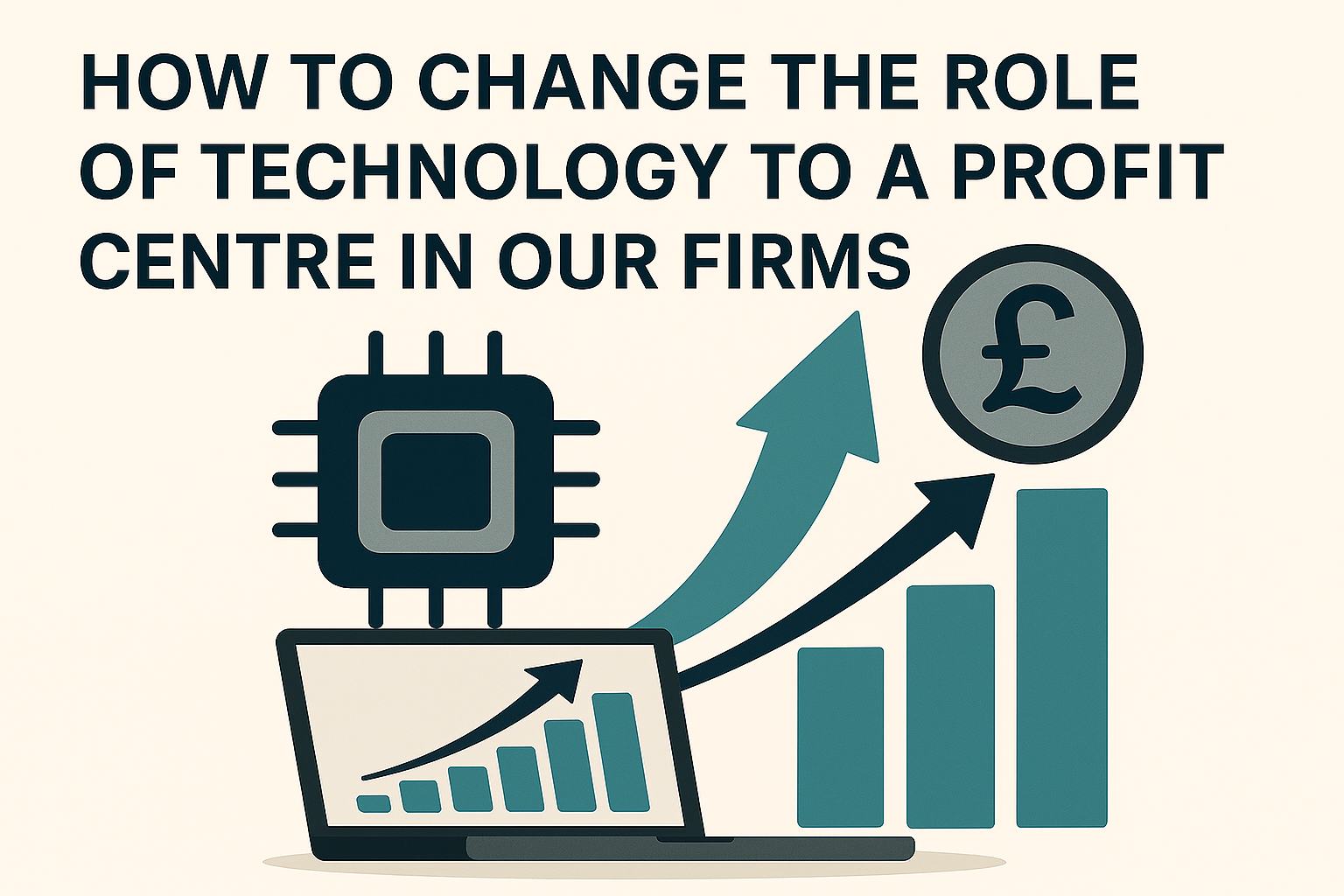
Most firms are still somewhere on their cloud adoption journey, but whether fully on-prem, cloud, or a blend - key data about people, clients, and projects are not fully connected. This presents a missed opportunity in not using this data to improve how the firm runs. Not the cliche of “actionable insights” from reporting, but using the data operationally to deliver more work, with more profit.

Professional services firms, including those in accountancy, are leaving growth on the table. Our latest report, Inside the leadership growth agenda reveals that one of the greatest threats to growth isn’t market volatility or client demand, but internal inefficiencies that can be controlled and fixed.
Often our work involves looking at the structure of technology functions within firms, and so for this article I thought I’d share our current thinking on optimal arrangements. The example I am using is split-out for larger firms, but for smaller firms the approach remains valid, just with some roles collapsed to fewer people.

Cloud costs have moved beyond IT and are now a board-level issue. As firms move more workloads to the cloud and adopt AI-driven services, spending is rising fast and becoming harder to predict.