Advancetrack outlines some of the first steps that an accountancy practice should take to manage internal IT security. We also chat to CTO Ian Gregory about Advancetrack’s approach to mitigating IT risk.


Accountancy practice management software has come a long way. Today, features like automated billing and reconciliations are easily integrated into the day-to-day practice workflow of Wolters Kluwer Tax & Accounting UK customers.
Our employees work side by side with our customers to create and manage these solutions – driven by a deep understanding of their needs and addressing the rapid changes in their environment.
However, it’s often hard to look beyond improving performance in day-to-day operations. Amid Brexit, the COVID-19 pandemic and other disruptions, accountancy practices and their clients are dealing with an unpredictable economic landscape. Future business planning can appear daunting.
However, technology can support accountancy practices (and their clients) in making informed business decisions, and planning for the future. In the first part of our Accountancy Practice Management for Future-Fit Growth series, we’ll explore how they can use technology to define and easily track Key Performance Indicators (KPIs). Doing so gives practices closer control of performance tracking, and deeper insights that will inform strategic growth plans.
Saving Time
For several decades, business technology platforms have enabled practices to track performance metrics that they have customised. This highlights areas that qualify for improvement and underpins strategic planning.
Contemporary technology, such as CCH KPI Monitoring, makes setting up KPIs faster and easier for accountancy practices than ever before. This is vital today. The current business landscape demands that firms assess and amend KPIs more frequently, based on fresh market variables. KPIs such as client retention rate and business time-to-recovery have become increasingly prominent performance indicators in the past year. If clunky technology makes KPI management difficult, practices have less time and insight to plan future growth.
.jpg)
Reducing Risk
CCH KPI Monitoring makes it far easier to track KPIs and report on them. This is fundamental in minimising risk. For example, if a KPI is set to track and escalate debt filtered by overdue dates, the ability to easily set alerts and automatically generate reports is critical to practice performance management.
Some practices are manually running monthly reports to measure KPIs. Others are running real-time reporting engines, a key feature of CCH KPI Monitoring. This latter solution allows practices to review essential data at any time – covering both performance management and compliance requirements. They can do so remotely or on-premise.
This means that firms can assess issues before they become problems, and thus act proactively. Real-time reporting is a true asset in building a future-fit practice.
The Proof is in the Practice
A number of Wolters Kluwer customers have been using CCH KPI Monitoring for several years now. Our customers look to us when they need to be right. Ryecroft Glenton has successfully integrated CCH KPI Monitoring with its own system. This consolidates information from several sources, including CCH Central and CCH Practice Management.
“We can use the year end date to trigger a sequence of reminders. Have we asked for the books? Have they been received? If a request to a client has been outstanding for a certain period, the partner will receive an alert via email. For limited companies, we can monitor the corporation tax and Companies House filing deadlines – as well as the different deadlines for pension schemes”
– Ian Smith, partner at Ryecroft Glenton
.jpg)
“Apogee are not just aprinting company, theyconsult with us and go onto deliver a full end to endservice from concept toinstallation. They go aboveand beyond and we lookforward to continuing ourjourney with them”


“Apogee are not just aprinting company, theyconsult with us and go onto deliver a full end to endservice from concept toinstallation. They go aboveand beyond and we lookforward to continuing ourjourney with them”

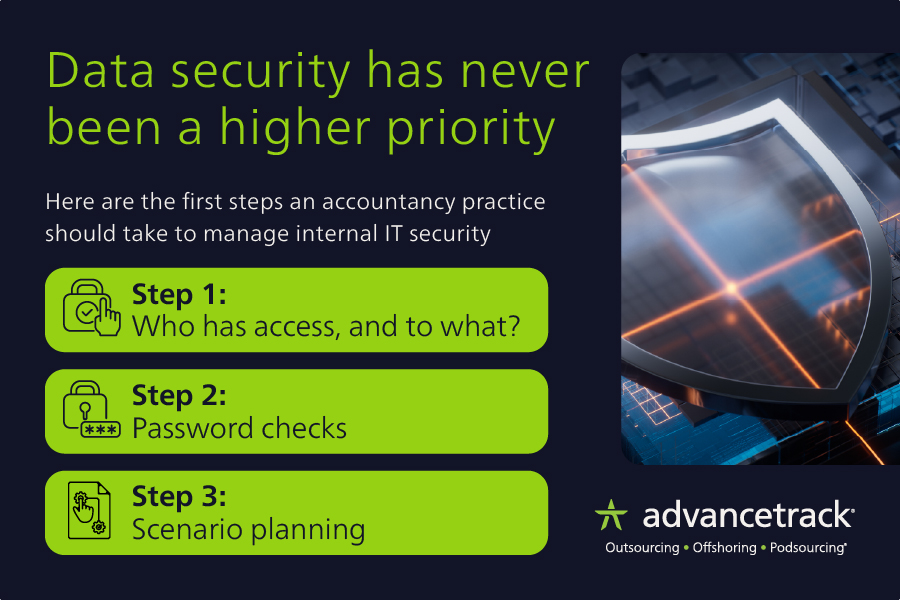
Data security has never been a higher priority. With numerous major organisations hit with data theft or IT breaches, maintaining secure access while enabling the business to operate feels like a balancing act.
Advancetrack works daily with accountancy firms, and so we understand the importance of having the right protocols and strategies in place.
Who has access, and to what?
How do you manage the access of sensitive documents between your practice and clients? If access management is unmanaged, you could find that clients have access to areas they no longer need access to, or worse, they’re not entitled to have access to, but because it was left unchecked, they still do.
Make sure that clients only have access to the things they need access to, so that they don’t have the wrong privileges when they don’t (or no longer) need them. Carefully document and track extra access within the firm itself; so that those with access are educated on the policies and procedures you have in place to protect their accounts and their data.
Password checks
Because of the beauty of password managers like LastPass, you don’t necessarily need to remember all your passwords, which gives you the opportunity to make them more complex without the pressure of potentially forgetting which letter was capitalised, or which letter was substituted for a number.
Two-factor authentication adds an extra layer of security to your password. This has become much more prominent with companies like Google and even Xero.
Another thing to be particularly careful of is usernames and passwords of past employees. It’s highly recommended that you delete these and change passwords so that any past employees, disgruntled or otherwise, aren’t tempted to log in again remotely.
Scenario planning
We caught up with our CTO Ian Gregory for his take on risk management from an Advancetrack perspective.
“There are many risk scenarios. The examples I usually cite are the three that cover the most ground. Firstly, what if a superstar’s accounts are put in front of our team – how do we make sure they can’t be stolen? The easiest thing to do would be to take pictures of them. To stop this, we don’t allow personal smartphones in our production office – and our staff, with one or two specific exceptions, do work in the office.
“Secondly, ransomware - it is a massive threat to accounting businesses. We reduce our attack surface by allowing non-managers only internal email, as well as things like security awareness training and phishing tests, plus some very expensive endpoint protection.
“The third risk I mentioned was disasters. What do you do when something actually happens? The first hour is most critical. I won’t go into detail on that, but we have processes and plans for many different disasters.
Do you have any final tips?
“The question they need to ask themselves is whether the security of their outsourcer is at least as good as their own security. Thinking through some of the key risks takes minutes, yet can quite literally save their practices from a huge amount of embarrassment were their outsourcer to let them down.”
Ian spoke on the Accounting Voices podcast last month about how AI can reshape accounting. It’s available via YouTube.
If you’d like to talk to us about your plans for the future, and where we could help, then please get in touch by clicking here.


Many organisations invest significant time and effort developing information governance policies. They run training, communicate expectations, and secure leadership support. On paper, everything looks ready for success.

Most firms are still somewhere on their cloud adoption journey, but whether fully on-prem, cloud, or a blend - key data about people, clients, and projects are not fully connected. This presents a missed opportunity in not using this data to improve how the firm runs. Not the cliche of “actionable insights” from reporting, but using the data operationally to deliver more work, with more profit.
CloudCapcha is inviting accounting leaders to rethink not just how time is captured, but what that data can reveal about performance, profitability and firm-wide efficiency.

Professional services firms, including those in accountancy, are leaving growth on the table. Our latest report, Inside the leadership growth agenda reveals that one of the greatest threats to growth isn’t market volatility or client demand, but internal inefficiencies that can be controlled and fixed.
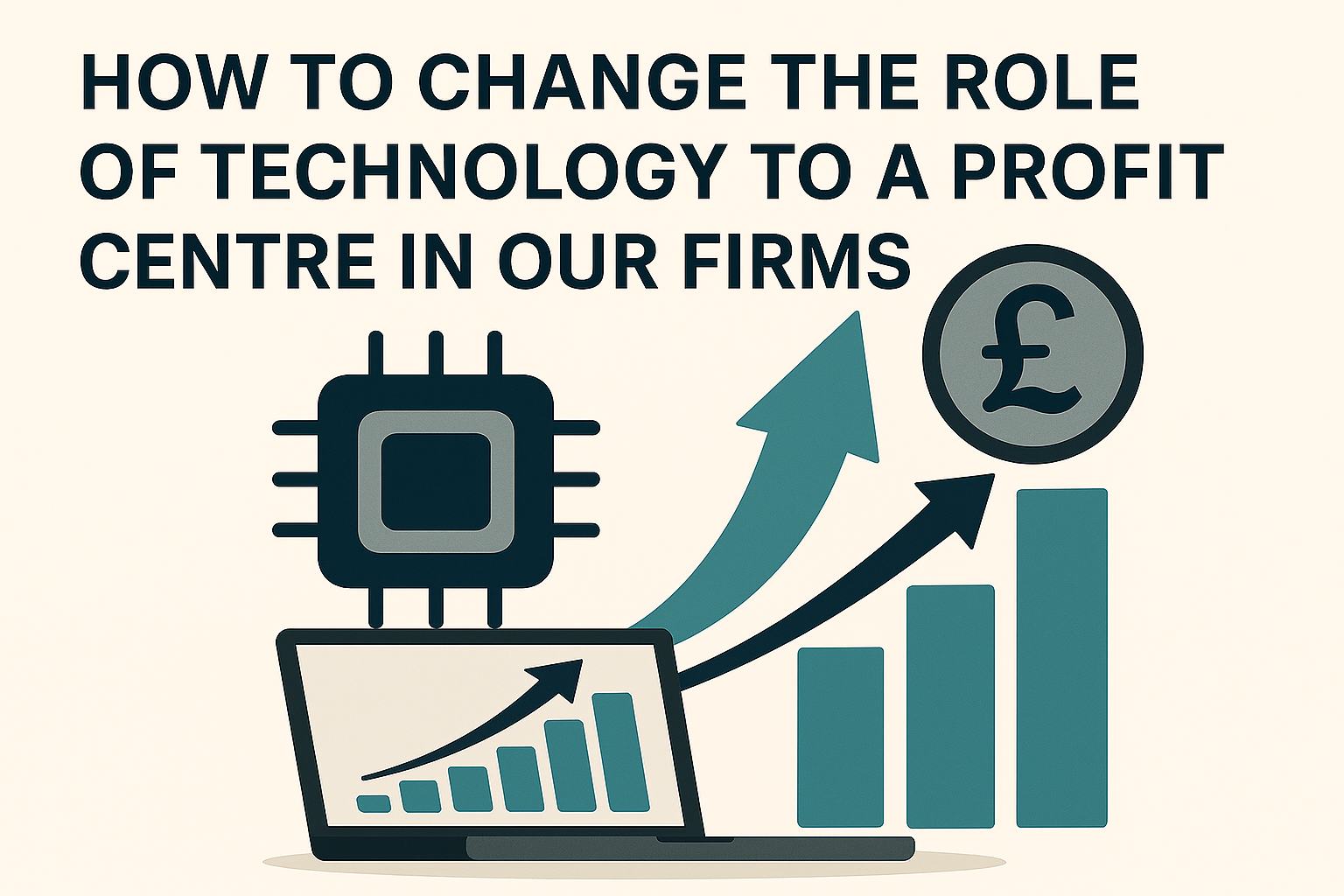
Often our work involves looking at the structure of technology functions within firms, and so for this article I thought I’d share our current thinking on optimal arrangements. The example I am using is split-out for larger firms, but for smaller firms the approach remains valid, just with some roles collapsed to fewer people.

Cloud costs have moved beyond IT and are now a board-level issue. As firms move more workloads to the cloud and adopt AI-driven services, spending is rising fast and becoming harder to predict.