Fixing the processes that have been frustrating your people for years!

By Quorum

Accountancy practice management software has come a long way. Today, features like automated billing and reconciliations are easily integrated into the day-to-day practice workflow of Wolters Kluwer Tax & Accounting UK customers.

Our employees work side by side with our customers to create and manage these solutions – driven by a deep understanding of their needs and addressing the rapid changes in their environment.

However, it’s often hard to look beyond improving performance in day-to-day operations. Amid Brexit, the COVID-19 pandemic and other disruptions, accountancy practices and their clients are dealing with an unpredictable economic landscape. Future business planning can appear daunting.

However, technology can support accountancy practices (and their clients) in making informed business decisions, and planning for the future. In the first part of our Accountancy Practice Management for Future-Fit Growth series, we’ll explore how they can use technology to define and easily track Key Performance Indicators (KPIs). Doing so gives practices closer control of performance tracking, and deeper insights that will inform strategic growth plans.

Saving Time

For several decades, business technology platforms have enabled practices to track performance metrics that they have customised. This highlights areas that qualify for improvement and underpins strategic planning.

Contemporary technology, such as CCH KPI Monitoring, makes setting up KPIs faster and easier for accountancy practices than ever before. This is vital today. The current business landscape demands that firms assess and amend KPIs more frequently, based on fresh market variables. KPIs such as client retention rate and business time-to-recovery have become increasingly prominent performance indicators in the past year. If clunky technology makes KPI management difficult, practices have less time and insight to plan future growth.

Reducing Risk
CCH KPI Monitoring makes it far easier to track KPIs and report on them. This is fundamental in minimising risk. For example, if a KPI is set to track and escalate debt filtered by overdue dates, the ability to easily set alerts and automatically generate reports is critical to practice performance management.

Some practices are manually running monthly reports to measure KPIs. Others are running real-time reporting engines, a key feature of CCH KPI Monitoring. This latter solution allows practices to review essential data at any time – covering both performance management and compliance requirements. They can do so remotely or on-premise.

This means that firms can assess issues before they become problems, and thus act proactively. Real-time reporting is a true asset in building a future-fit practice.

The Proof is in the Practice
A number of Wolters Kluwer customers have been using CCH KPI Monitoring for several years now. Our customers look to us when they need to be right. Ryecroft Glenton has successfully integrated CCH KPI Monitoring with its own system. This consolidates information from several sources, including CCH Central and CCH Practice Management.

“We can use the year end date to trigger a sequence of reminders. Have we asked for the books? Have they been received? If a request to a client has been outstanding for a certain period, the partner will receive an alert via email. For limited companies, we can monitor the corporation tax and Companies House filing deadlines – as well as the different deadlines for pension schemes”

– Ian Smith, partner at Ryecroft Glenton

Corporate events agency who benefited from greener graphics initiative

“Apogee are not just aprinting company, theyconsult with us and go onto deliver a full end to endservice from concept toinstallation. They go aboveand beyond and we lookforward to continuing ourjourney with them”

Corporate events agency who benefited from greener graphics initiative

“Apogee are not just aprinting company, theyconsult with us and go onto deliver a full end to endservice from concept toinstallation. They go aboveand beyond and we lookforward to continuing ourjourney with them”

Corporate events agency who benefited from greener graphics initiative

“Apogee are not just aprinting company, theyconsult with us and go onto deliver a full end to endservice from concept toinstallation. They go aboveand beyond and we lookforward to continuing ourjourney with them”

Corporate events agency who benefited from greener graphics initiative

“Apogee are not just aprinting company, theyconsult with us and go onto deliver a full end to endservice from concept toinstallation. They go aboveand beyond and we lookforward to continuing ourjourney with them”

Every week seems to bring a new AI model, assistant, feature ad nauseam and lots of companies have spent the past couple of years asking: "How do we use AI?"

While that's a reasonable question, it's probably not that useful.

You’ll see a lot more value from taking a step back and rather than looking at the technology first, look at what you do and what you could do better.

A more useful question to ask is this:

Which business processes consume time, follow clear rules and happen repeatedly?

We’re all familiar with AI assistants now: ask a question, upload a document or draft some text and get something back. While this is undoubtedly useful, we're moving beyond assistance and into execution.

Instead of helping you complete a task, AI can increasingly carry out parts of the task itself e.g. gathering information, updating records, triggering actions, passing work to the next person in the process.

Many of the most valuable uses of AI help with improving business processes.

That's why technology like Model Context Protocol (MCP) matters.

Despite the rather uninspiring name, MCP is quickly becoming one of the most important developments in practical AI. You could describe it as "USB-C for AI" because it provides a standard way for AI tools to connect to data, systems and actions rather than relying on countless one-off, bespoke integrations.

Let’s look at a couple of examples:

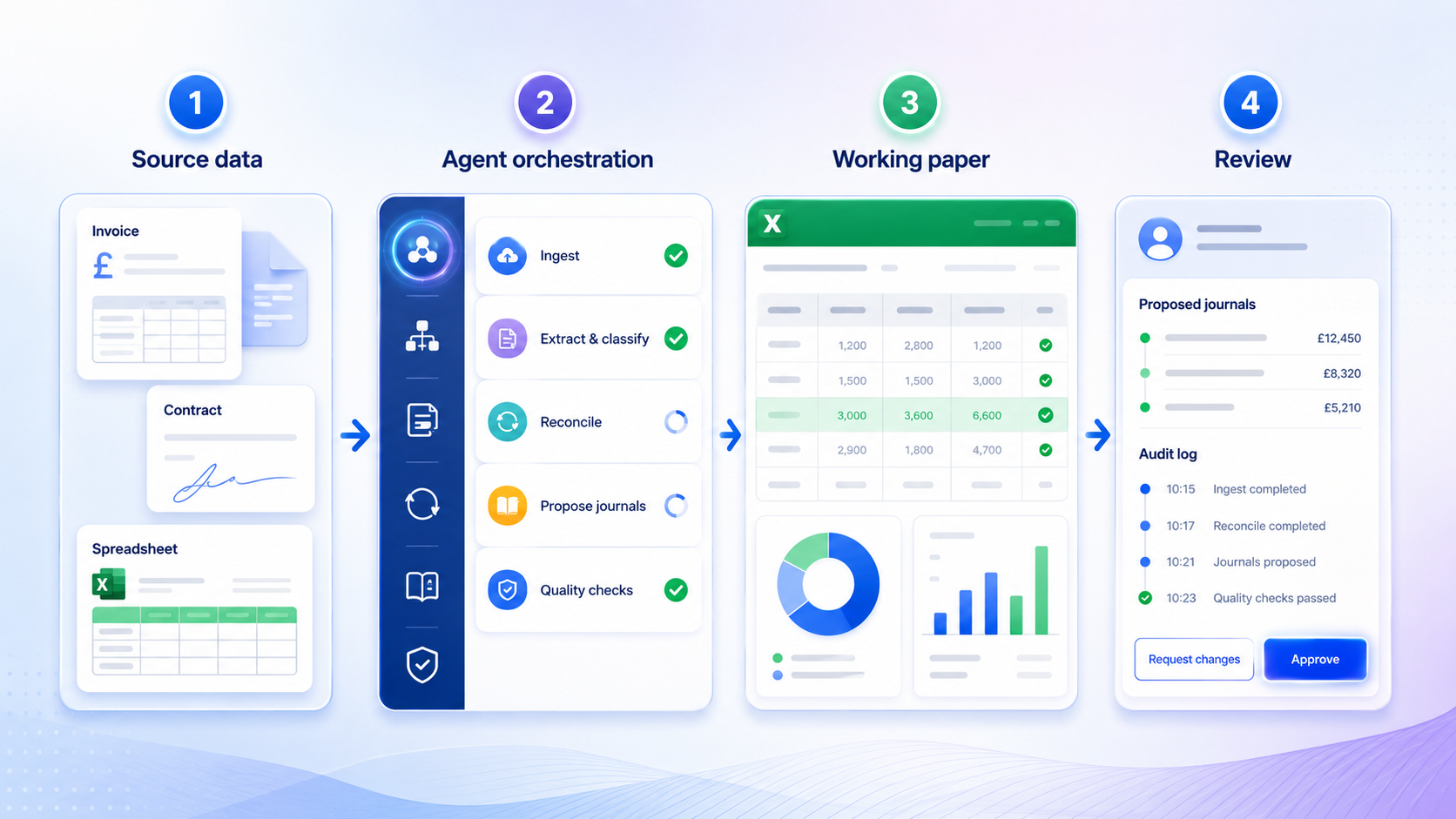
Consider a year-end accounts preparation process. Information may sit across your practice management system, document management platform, email conversations and working papers. An AI agent could gather the relevant information, identify missing documents, update internal tracking records and route exceptions to the right person for review. The process still has an owner and so human oversight remains. It just removes the manual effort.

Or take an AML or client onboarding process. Rather than manually checking multiple systems, chasing information and updating records, AI can retrieve information from the relevant sources, flag missing requirements, trigger follow-up actions and keep the process moving.

Many firms are still treating AI as a productivity tool for individual users.

A bigger impact will come from looking at the operational friction that exists across your firm and identifying where information gets stuck, duplicated or delayed.

And most importantly, this doesn't require abandoning governance. In fact, some of the most promising developments are built around preserving it.

AI can work within existing permissions. Audit trails remain intact. Approval processes can still require human sign-off and rather than bypassing controls, the technology can operate within them.

We think it’s most sensible to stop chasing the flashiest new stuff and shoehorning a way to use it and identify where AI can genuinely remove effort without increasing risk.

So instead of asking:

"What can AI do?"

Try asking:

"What work are our people still doing manually that they shouldn't have to?"

As both a Microsoft partner and an iManage partner, Quorum is helping organisations explore how technologies like Microsoft 365, iManage, and beyond can work with AI together to create practical, governed business processes.

If you're exploring MCP, Copilot Studio, AI agents or process automation, start with one process. Map the systems involved. Identify the bottlenecks. Then ask what could be delegated safely and effectively.

You might find that your biggest opportunity comes from fixing the processes that have been frustrating your people for years!

If you'd like to explore where AI, MCP and connected business systems could deliver measurable value in your firm, we’re offering a free workshop or discovery session - https://bit.ly/AIConsultationRequest

Aug 2026

Technology Debt: The Hidden Challenge Facing Growing Accountancy Firms

The accountancy profession has never faced more opportunity—or more complexity.

How do you do more with less?

Clients want proactive advisory, not just compliance. Practices are struggling to deliver that without adding headcount or radically changing how they work.

Turning Governance Intent into a Practical Plan

Once organisations begin to recognise the scale of this challenge, the next question naturally follows: how do we start addressing it in a practical way?

Is your AI investment creating real capacity?

When KPMG pressed its own auditor for a 14% fee cut earlier this year, arguing that AI was reducing the cost to deliver, it handed every client of every firm the same script.

Beyond the AI noise: 5 insights for professional services leaders from Dayshape and Microsoft

AI investment is accelerating, but the biggest opportunity isn’t helping individuals work faster. It’s helping entire firms operate better.

Close management’s next phase: from collaboration to orchestration

Close management software has traditionally helped firms bring order to a demanding process. It standardises working papers, checklists and procedures, assigns responsibilities and gives teams a shared view of progress across a portfolio of clients.