Is your AI investment creating real capacity?

By Beeye

Accountancy practice management software has come a long way. Today, features like automated billing and reconciliations are easily integrated into the day-to-day practice workflow of Wolters Kluwer Tax & Accounting UK customers.

Our employees work side by side with our customers to create and manage these solutions – driven by a deep understanding of their needs and addressing the rapid changes in their environment.

However, it’s often hard to look beyond improving performance in day-to-day operations. Amid Brexit, the COVID-19 pandemic and other disruptions, accountancy practices and their clients are dealing with an unpredictable economic landscape. Future business planning can appear daunting.

However, technology can support accountancy practices (and their clients) in making informed business decisions, and planning for the future. In the first part of our Accountancy Practice Management for Future-Fit Growth series, we’ll explore how they can use technology to define and easily track Key Performance Indicators (KPIs). Doing so gives practices closer control of performance tracking, and deeper insights that will inform strategic growth plans.

Saving Time

For several decades, business technology platforms have enabled practices to track performance metrics that they have customised. This highlights areas that qualify for improvement and underpins strategic planning.

Contemporary technology, such as CCH KPI Monitoring, makes setting up KPIs faster and easier for accountancy practices than ever before. This is vital today. The current business landscape demands that firms assess and amend KPIs more frequently, based on fresh market variables. KPIs such as client retention rate and business time-to-recovery have become increasingly prominent performance indicators in the past year. If clunky technology makes KPI management difficult, practices have less time and insight to plan future growth.

Reducing Risk
CCH KPI Monitoring makes it far easier to track KPIs and report on them. This is fundamental in minimising risk. For example, if a KPI is set to track and escalate debt filtered by overdue dates, the ability to easily set alerts and automatically generate reports is critical to practice performance management.

Some practices are manually running monthly reports to measure KPIs. Others are running real-time reporting engines, a key feature of CCH KPI Monitoring. This latter solution allows practices to review essential data at any time – covering both performance management and compliance requirements. They can do so remotely or on-premise.

This means that firms can assess issues before they become problems, and thus act proactively. Real-time reporting is a true asset in building a future-fit practice.

The Proof is in the Practice
A number of Wolters Kluwer customers have been using CCH KPI Monitoring for several years now. Our customers look to us when they need to be right. Ryecroft Glenton has successfully integrated CCH KPI Monitoring with its own system. This consolidates information from several sources, including CCH Central and CCH Practice Management.

“We can use the year end date to trigger a sequence of reminders. Have we asked for the books? Have they been received? If a request to a client has been outstanding for a certain period, the partner will receive an alert via email. For limited companies, we can monitor the corporation tax and Companies House filing deadlines – as well as the different deadlines for pension schemes”

– Ian Smith, partner at Ryecroft Glenton

Corporate events agency who benefited from greener graphics initiative

“Apogee are not just aprinting company, theyconsult with us and go onto deliver a full end to endservice from concept toinstallation. They go aboveand beyond and we lookforward to continuing ourjourney with them”


Corporate events agency who benefited from greener graphics initiative

“Apogee are not just aprinting company, theyconsult with us and go onto deliver a full end to endservice from concept toinstallation. They go aboveand beyond and we lookforward to continuing ourjourney with them”

Corporate events agency who benefited from greener graphics initiative

“Apogee are not just aprinting company, theyconsult with us and go onto deliver a full end to endservice from concept toinstallation. They go aboveand beyond and we lookforward to continuing ourjourney with them”
Corporate events agency who benefited from greener graphics initiative

“Apogee are not just aprinting company, theyconsult with us and go onto deliver a full end to endservice from concept toinstallation. They go aboveand beyond and we lookforward to continuing ourjourney with them”

When KPMG pressed its own auditor for a 14% fee cut earlier this year, arguing that AI was reducing the cost to deliver, it handed every client of every firm the same script.

That lands differently on IT than on the partners. According to the Accountancy Age Top 50+50 report, median technology spend across the UK's 100 largest firms now sits just under £300,000, with the top quartile above £900,000. The same report names margin pressure and tighter pricing discipline as a defining force for 2026. The squeeze arrives from both directions at once: clients expect AI savings passed through, and the board expects the technology budget to show a return. Reconciling those two demands usually falls to whoever signed off the stack.

The question your stack can't answer

A 2025 Xero and Cebr study, cited in the Top 50+50 report, found 98% of UK accounting practices now use AI in some form, cutting time on routine tasks by around a third. Adoption is no longer the question. The uncomfortable one that follows: if AI has taken a third of the time out of routine tax and audit work, where did those hours go?

Most firms can't answer, and not because the AI underdelivered. The hours are real. But when a piece of work takes less time than planned, something, or someone, has to route the next piece of work and record that it happened. Otherwise, the capacity evaporates: the firm gave the fee discount and the freed time never became billable work. The same applies looking forward. If returns will take 30% less time next season, staffing plans, pricing and capacity forecasts should already reflect that. Both answers depend on the same underlying asset: task-level data on who is doing what work, for how long, at what cost.

Why it's an architecture problem

Strip it back to the event that actually needs handling: Using AI means a piece of work finishes early, and someone has a few hours they weren't scheduled to have. In most stacks, nothing handles that moment, because the capability is split across multiple systems. Some practice management platforms do schedule at the task level, but the scheduling is manual: nothing detects the freed hours or proposes the next piece of work, so reallocation depends on a manager noticing or the staff member self-serving.

Resource management tools that do offer automated, proactive matching typically work at the engagement level, a unit far too coarse to catch hours recovered task by task. Either way, the answer to "where did the hours go?" is the same: nowhere anyone can see. And in most firms the underlying data is scattered across practice management, workflow tools, timesheets and departmental spreadsheets.

Firms keep buying AI to do the work faster. Meanwhile, the layer that would prove the work got faster, and redeploy the time it saved, doesn't exist in the stack at all.

What's missing is the combination: automated, proactive matching operating at the task level, integrated with practice management, workflow and time data. When a task completes early, the next one routes to the best available person, and the variance is recorded so the firm can prove where the hours went. One version of the truth, entered once, flowing through documented APIs rather than manual exports and spreadsheets.

This combination is what Beeye was built for, integrating with the systems firms already run, from CCH and IRIS to Outlook and Power BI. As Ben Brownson, Group Board Director & Head of Operations at RPG Chartered Accountants, put it: "We were inefficient in using two systems to allocate work and build reports. Beeye has given us a shared picture of upcoming work, statuses, capacity, scheduled hours, and budgets in one place."

Whatever tooling you choose, the requirement stands. When the fee pressure arrives, the defensible firms will be those whose IT leaders have supported the business with tooling to show which work got faster, where the recovered hours went, and the upside.

Aug 2026

Technology Debt: The Hidden Challenge Facing Growing Accountancy Firms

The accountancy profession has never faced more opportunity—or more complexity.

How do you do more with less?

Clients want proactive advisory, not just compliance. Practices are struggling to deliver that without adding headcount or radically changing how they work.

Turning Governance Intent into a Practical Plan

Once organisations begin to recognise the scale of this challenge, the next question naturally follows: how do we start addressing it in a practical way?

Beyond the AI noise: 5 insights for professional services leaders from Dayshape and Microsoft

AI investment is accelerating, but the biggest opportunity isn’t helping individuals work faster. It’s helping entire firms operate better.

Fixing the processes that have been frustrating your people for years!

Every week seems to bring a new AI model, assistant, feature ad nauseam and lots of companies have spent the past couple of years asking: "How do we use AI?"

Close management’s next phase: from collaboration to orchestration

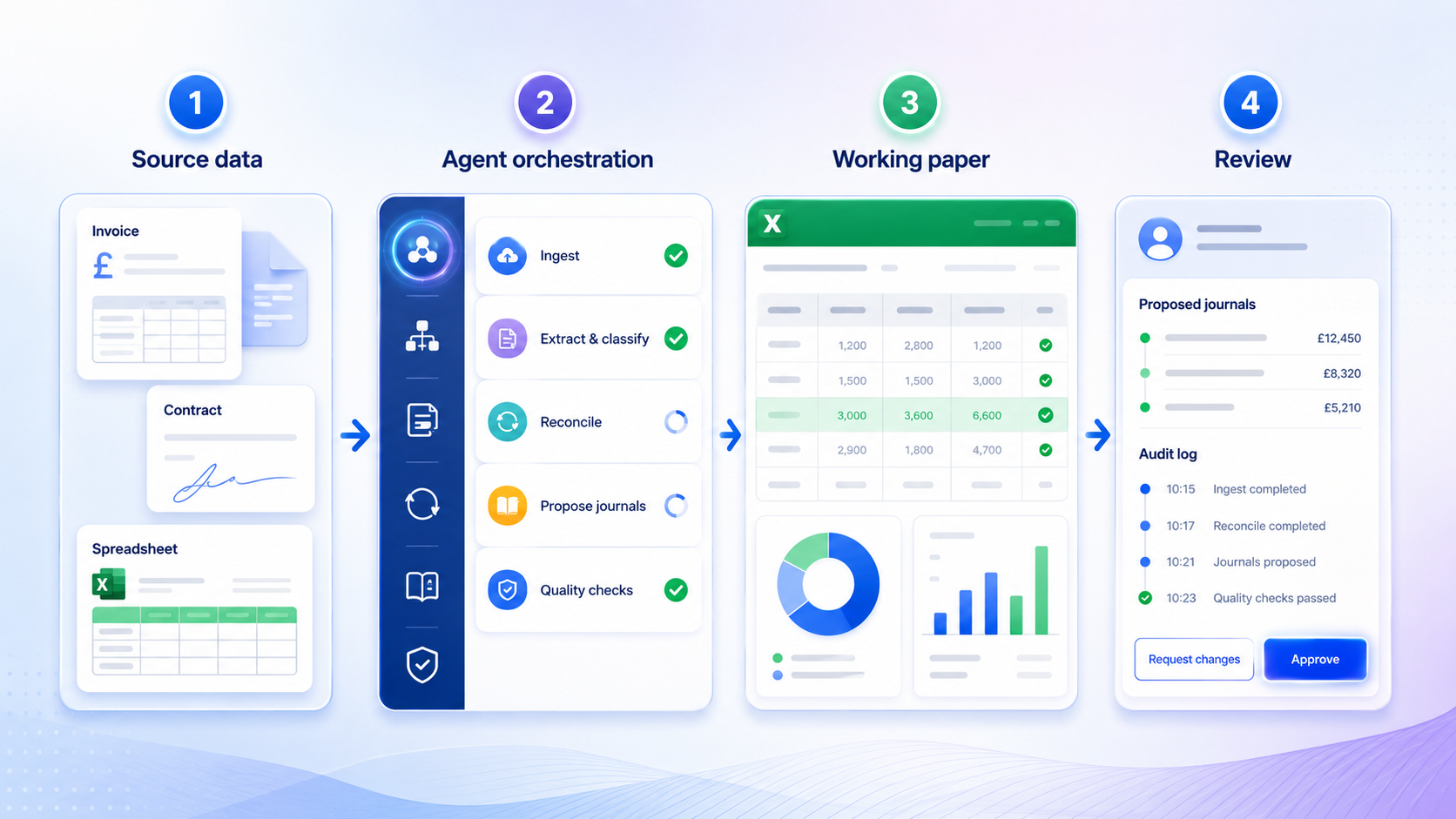
Close management software has traditionally helped firms bring order to a demanding process. It standardises working papers, checklists and procedures, assigns responsibilities and gives teams a shared view of progress across a portfolio of clients.