Beyond the AI noise: 5 insights for professional services leaders from Dayshape and Microsoft

By Dayshape

Accountancy practice management software has come a long way. Today, features like automated billing and reconciliations are easily integrated into the day-to-day practice workflow of Wolters Kluwer Tax & Accounting UK customers.

Our employees work side by side with our customers to create and manage these solutions – driven by a deep understanding of their needs and addressing the rapid changes in their environment.

However, it’s often hard to look beyond improving performance in day-to-day operations. Amid Brexit, the COVID-19 pandemic and other disruptions, accountancy practices and their clients are dealing with an unpredictable economic landscape. Future business planning can appear daunting.

However, technology can support accountancy practices (and their clients) in making informed business decisions, and planning for the future. In the first part of our Accountancy Practice Management for Future-Fit Growth series, we’ll explore how they can use technology to define and easily track Key Performance Indicators (KPIs). Doing so gives practices closer control of performance tracking, and deeper insights that will inform strategic growth plans.

Saving Time

For several decades, business technology platforms have enabled practices to track performance metrics that they have customised. This highlights areas that qualify for improvement and underpins strategic planning.

Contemporary technology, such as CCH KPI Monitoring, makes setting up KPIs faster and easier for accountancy practices than ever before. This is vital today. The current business landscape demands that firms assess and amend KPIs more frequently, based on fresh market variables. KPIs such as client retention rate and business time-to-recovery have become increasingly prominent performance indicators in the past year. If clunky technology makes KPI management difficult, practices have less time and insight to plan future growth.

Reducing Risk
CCH KPI Monitoring makes it far easier to track KPIs and report on them. This is fundamental in minimising risk. For example, if a KPI is set to track and escalate debt filtered by overdue dates, the ability to easily set alerts and automatically generate reports is critical to practice performance management.

Some practices are manually running monthly reports to measure KPIs. Others are running real-time reporting engines, a key feature of CCH KPI Monitoring. This latter solution allows practices to review essential data at any time – covering both performance management and compliance requirements. They can do so remotely or on-premise.

This means that firms can assess issues before they become problems, and thus act proactively. Real-time reporting is a true asset in building a future-fit practice.

The Proof is in the Practice
A number of Wolters Kluwer customers have been using CCH KPI Monitoring for several years now. Our customers look to us when they need to be right. Ryecroft Glenton has successfully integrated CCH KPI Monitoring with its own system. This consolidates information from several sources, including CCH Central and CCH Practice Management.

“We can use the year end date to trigger a sequence of reminders. Have we asked for the books? Have they been received? If a request to a client has been outstanding for a certain period, the partner will receive an alert via email. For limited companies, we can monitor the corporation tax and Companies House filing deadlines – as well as the different deadlines for pension schemes”

– Ian Smith, partner at Ryecroft Glenton

Corporate events agency who benefited from greener graphics initiative

“Apogee are not just aprinting company, theyconsult with us and go onto deliver a full end to endservice from concept toinstallation. They go aboveand beyond and we lookforward to continuing ourjourney with them”
Corporate events agency who benefited from greener graphics initiative

“Apogee are not just aprinting company, theyconsult with us and go onto deliver a full end to endservice from concept toinstallation. They go aboveand beyond and we lookforward to continuing ourjourney with them”

Corporate events agency who benefited from greener graphics initiative

“Apogee are not just aprinting company, theyconsult with us and go onto deliver a full end to endservice from concept toinstallation. They go aboveand beyond and we lookforward to continuing ourjourney with them”

Corporate events agency who benefited from greener graphics initiative

“Apogee are not just aprinting company, theyconsult with us and go onto deliver a full end to endservice from concept toinstallation. They go aboveand beyond and we lookforward to continuing ourjourney with them”

AI investment is accelerating, but the biggest opportunity isn’t helping individuals work faster. It’s helping entire firms operate better.

During a recent workshop, Andrew Bone, VP Product and Co-founder at Dayshape, joined Brant Hollenkamp, Microsoft’s Professional Services Industry Leader, to explore how professional services firms can move beyond AI experimentation and create greater operational impact.

Read on for the key insights below or watch the full on-demand workshop.

1.   The AI experimentation era is over

AI has moved from innovation teams to the boardroom.

That's one of the biggest shifts Brant has seen across Microsoft's customers over the past year. Executive conversations are no longer centred on AI adoption or what's possible. Instead, leaders are asking different questions. Where is AI creating value? How do we demonstrate ROI? And how do we use AI to strengthen competitive advantage?

“The technology is pretty well proven. Today we’re having conversations with leaders around outcomes, value creation, competitive advantage, and ultimately how to drive growth.”

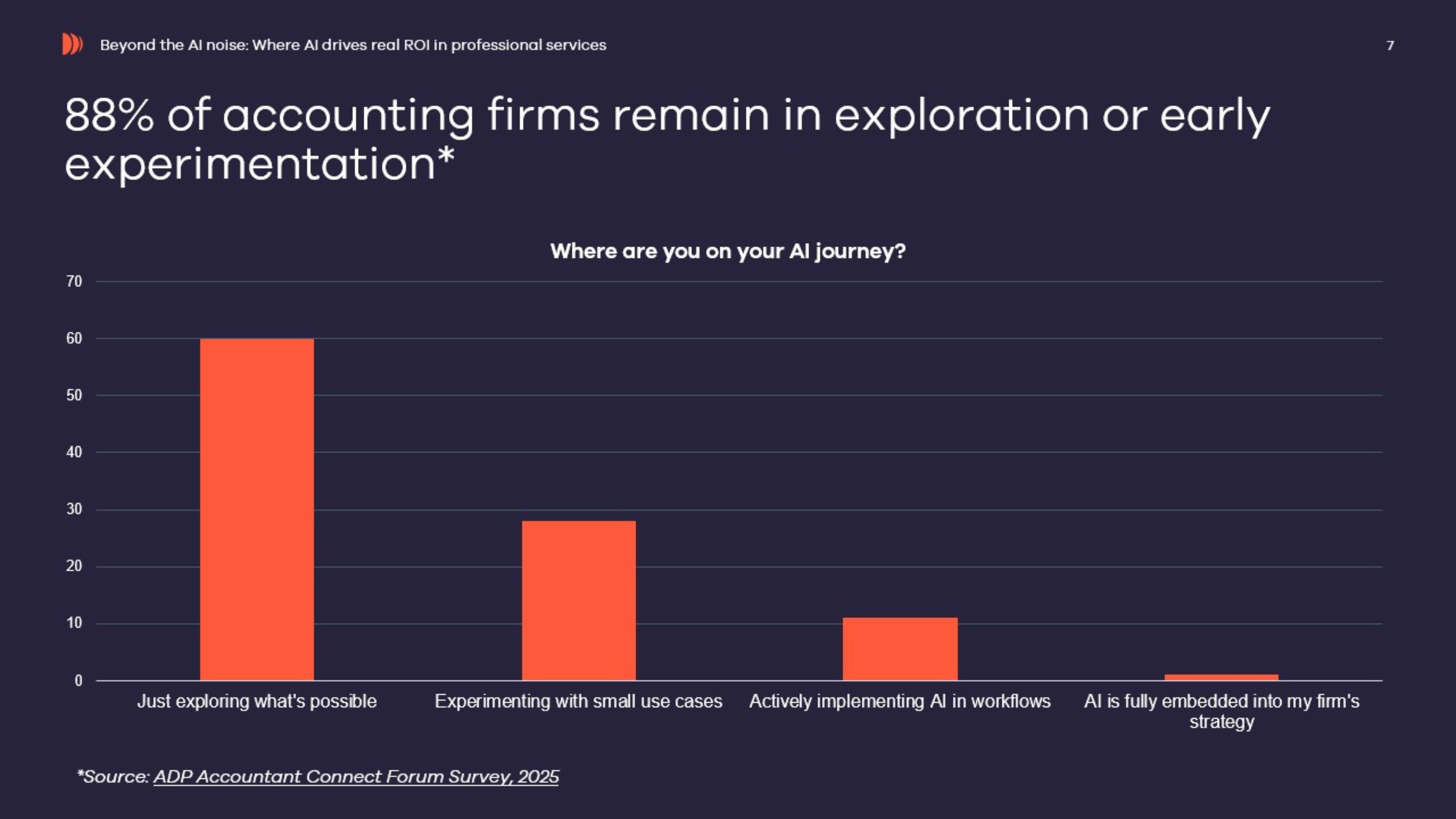
Recent ADP research referenced during the workshop found that 88% of accounting firms remain in the exploration or early experimentation phase of AI adoption.

Yet firms are already looking ahead. Our own research found that 39% of large professional services firms plan to invest in AI for scheduling and capacity modelling, signalling a shift toward applying AI to the operational challenges that shape firm performance.

Andrew is seeing a similar trend across professional services firms. AI has made it easier than ever for individuals to build useful tools, agents, and workflows. The harder challenge is turning those individual successes into firm-wide adoption.

As Andrew explained:  

“AI makes it easier to build something useful. It does necessarily make it much easier to drive adoption. That requires change management, advocacy, training, and leadership.”

2.  AI’s greatest opportunity lies in operations

The AI conversation is evolving. The first wave focused on helping individuals work faster. The next is about helping entire firms operate better.

As Brant explained, AI assistants have helped address the "productivity gap" by making everyday tasks more efficient. But as organisations become more mature in their AI journey, the opportunity shifts from productivity to operations.

Andrew sees that shift happening across professional services too.

“The more interesting question is what happens when AI starts helping entire firms operate better.”

Rather than simply helping people complete the same tasks faster, Andrew believes AI has the potential to fundamentally change how firms plan, resource, and deliver their work.

He highlighted two opportunities where AI can make the biggest impact.

The first is operational insight. Firms already hold rich operational data, but it's not always available to the right people at the right time. AI can democratise access to that information, surfacing risks and opportunities as they emerge rather than waiting for reports or dashboards.

The second is operational action.

“Don’t just bring me a problem. Bring me a solution. The same applies to AI.”

Rather than simply identifying issues, AI can recommend practical next steps, helping firms make better operational decisions while keeping people firmly at the centre of the process.

As Brant summarised:

“The goal isn’t to automate decision making. It’s to improve decision making.”

Andrew is already seeing this approach deliver measurable results.

Big Four customer spotlight

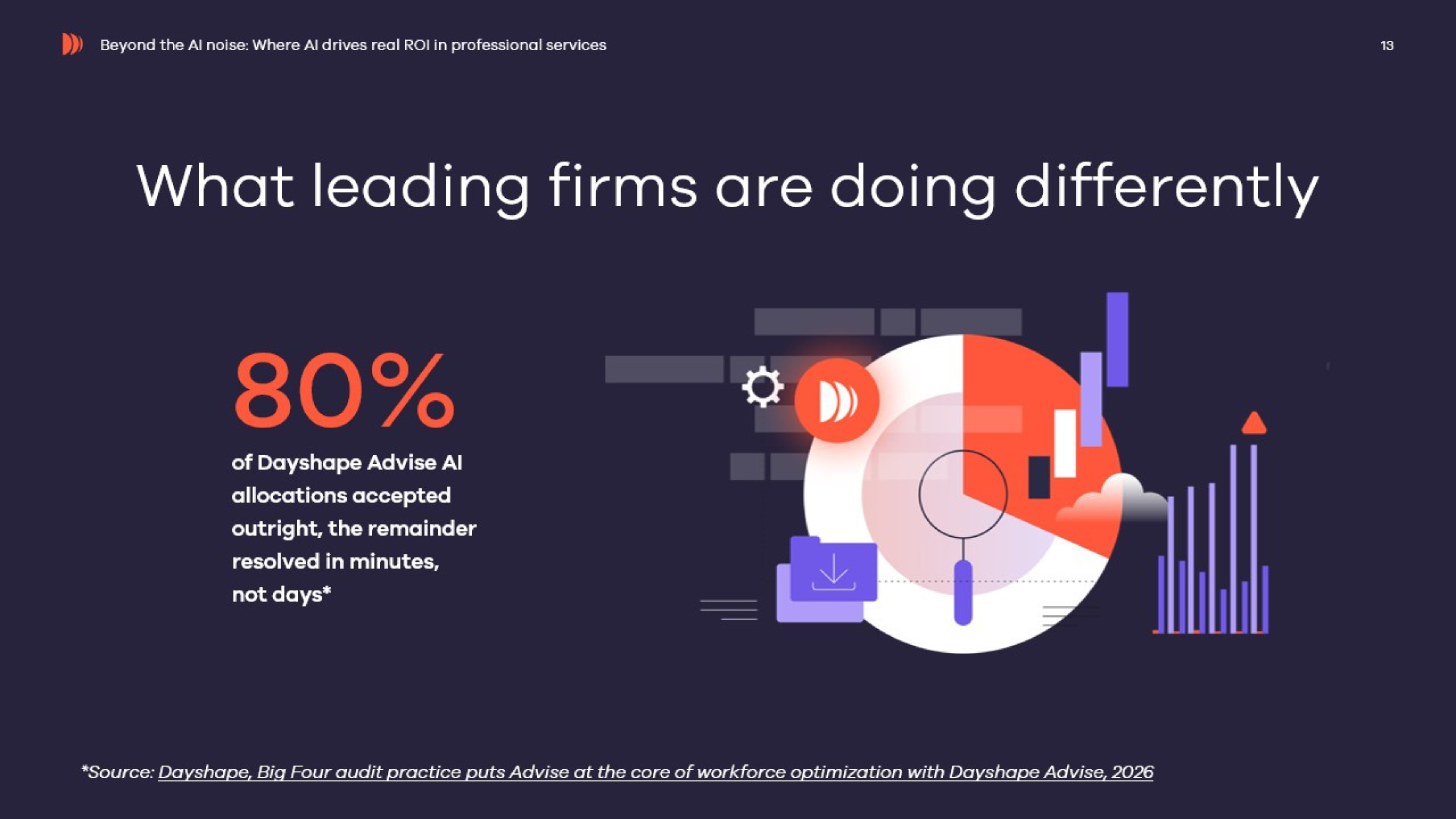
One Big Four audit practice used Dayshape Advise to allocate new graduate hires.

80% of AI-generated allocations were accepted outright
‍–
The remaining recommendations were refined in minutes rather than days

It's a practical example of AI augmenting human expertise rather than replacing it, helping firms make better operational decisions at scale.

Read more or watch the workshop in full

These two insights are just a snapshot of the conversation between Andrew and Brant.

Explore all five key insights or watch the on-demand workshop in full to learn where AI is already creating measurable value across planning, resourcing, and delivery.

Aug 2026

Technology Debt: The Hidden Challenge Facing Growing Accountancy Firms

The accountancy profession has never faced more opportunity—or more complexity.

How do you do more with less?

Clients want proactive advisory, not just compliance. Practices are struggling to deliver that without adding headcount or radically changing how they work.

Turning Governance Intent into a Practical Plan

Once organisations begin to recognise the scale of this challenge, the next question naturally follows: how do we start addressing it in a practical way?

Is your AI investment creating real capacity?

When KPMG pressed its own auditor for a 14% fee cut earlier this year, arguing that AI was reducing the cost to deliver, it handed every client of every firm the same script.

Fixing the processes that have been frustrating your people for years!

Every week seems to bring a new AI model, assistant, feature ad nauseam and lots of companies have spent the past couple of years asking: "How do we use AI?"

Close management’s next phase: from collaboration to orchestration

Close management software has traditionally helped firms bring order to a demanding process. It standardises working papers, checklists and procedures, assigns responsibilities and gives teams a shared view of progress across a portfolio of clients.