By Raj Chambore


Accountancy practice management software has come a long way. Today, features like automated billing and reconciliations are easily integrated into the day-to-day practice workflow of Wolters Kluwer Tax & Accounting UK customers.
Our employees work side by side with our customers to create and manage these solutions – driven by a deep understanding of their needs and addressing the rapid changes in their environment.
However, it’s often hard to look beyond improving performance in day-to-day operations. Amid Brexit, the COVID-19 pandemic and other disruptions, accountancy practices and their clients are dealing with an unpredictable economic landscape. Future business planning can appear daunting.
However, technology can support accountancy practices (and their clients) in making informed business decisions, and planning for the future. In the first part of our Accountancy Practice Management for Future-Fit Growth series, we’ll explore how they can use technology to define and easily track Key Performance Indicators (KPIs). Doing so gives practices closer control of performance tracking, and deeper insights that will inform strategic growth plans.
Saving Time
For several decades, business technology platforms have enabled practices to track performance metrics that they have customised. This highlights areas that qualify for improvement and underpins strategic planning.
Contemporary technology, such as CCH KPI Monitoring, makes setting up KPIs faster and easier for accountancy practices than ever before. This is vital today. The current business landscape demands that firms assess and amend KPIs more frequently, based on fresh market variables. KPIs such as client retention rate and business time-to-recovery have become increasingly prominent performance indicators in the past year. If clunky technology makes KPI management difficult, practices have less time and insight to plan future growth.
.jpg)
Reducing Risk
CCH KPI Monitoring makes it far easier to track KPIs and report on them. This is fundamental in minimising risk. For example, if a KPI is set to track and escalate debt filtered by overdue dates, the ability to easily set alerts and automatically generate reports is critical to practice performance management.
Some practices are manually running monthly reports to measure KPIs. Others are running real-time reporting engines, a key feature of CCH KPI Monitoring. This latter solution allows practices to review essential data at any time – covering both performance management and compliance requirements. They can do so remotely or on-premise.
This means that firms can assess issues before they become problems, and thus act proactively. Real-time reporting is a true asset in building a future-fit practice.
The Proof is in the Practice
A number of Wolters Kluwer customers have been using CCH KPI Monitoring for several years now. Our customers look to us when they need to be right. Ryecroft Glenton has successfully integrated CCH KPI Monitoring with its own system. This consolidates information from several sources, including CCH Central and CCH Practice Management.
“We can use the year end date to trigger a sequence of reminders. Have we asked for the books? Have they been received? If a request to a client has been outstanding for a certain period, the partner will receive an alert via email. For limited companies, we can monitor the corporation tax and Companies House filing deadlines – as well as the different deadlines for pension schemes”
– Ian Smith, partner at Ryecroft Glenton
.jpg)
“Apogee are not just aprinting company, theyconsult with us and go onto deliver a full end to endservice from concept toinstallation. They go aboveand beyond and we lookforward to continuing ourjourney with them”



“Apogee are not just aprinting company, theyconsult with us and go onto deliver a full end to endservice from concept toinstallation. They go aboveand beyond and we lookforward to continuing ourjourney with them”


In the first article in this series, we explored how data sprawl develops and why unmanaged information can quietly become a source of operational and regulatory risk. Once organisations begin to recognise the scale of this challenge, the next question naturally follows: how do we start addressing it in a practical way?
For many firms, this is the point where governance initiatives stall. There is usually widespread agreement that information management needs improvement. Leadership teams understand the potential risks associated with uncontrolled data growth, technology teams see the operational strain created by expanding storage environments, and compliance professionals recognise that regulators and clients are asking more questions about how information is handled.
Despite this shared awareness, turning intention into action can be difficult. Governance programmes often appear too large, too disruptive or too complex to implement alongside the everyday demands of client work.
The reality, however, is that effective governance rarely begins with a large transformation programme. Instead it starts with a realistic assessment of where the organisation currently stands.
Starting with visibility rather than ambition
A common mistake organisations make when approaching governance is trying to design a perfect future state before understanding their current environment. Policies are drafted, frameworks are developed and ambitious targets are set, yet these plans may not reflect the practical realities of how information is currently stored and managed.
A more effective starting point is visibility.
Organisations need to understand the shape of their information landscape before they can manage it effectively. This means identifying where information resides across the business and gaining insight into how different teams handle their records.
Several questions often provide useful clarity:
– Which systems store the majority of organisational data?
– How consistent are retention practices across departments?
– Are there legacy repositories that have never been reviewed?
– Who currently makes decisions about information disposal?
– What evidence could the organisation provide if a regulator or client requested confirmation of its information management practices?
The answers to these questions rarely reveal chaos. In most cases they highlight uneven maturity. Some teams may already operate with strong information discipline, while others rely more heavily on local practices or historic habits.
Understanding these differences allows firms to focus their efforts where governance improvements will have the greatest impact.
Prioritising the areas that matter most
Once organisations develop a clearer view of their information environment, the next step is prioritisation.
Governance initiatives often lose momentum when firms attempt to address every issue simultaneously. The scope quickly becomes overwhelming, and the programme risks losing support before meaningful progress is achieved.
Instead, organisations benefit from focusing first on areas where governance improvements will deliver the greatest value. These may include repositories that contain particularly sensitive data, systems that hold large volumes of historical information or environments where retention practices are inconsistent.
Prioritisation also allows governance teams to demonstrate early progress. When organisations see tangible improvements in targeted areas, confidence in the governance programme increases and further investment becomes easier to justify.
Designing a phased governance strategy
Successful governance initiatives typically follow a phased approach rather than attempting to transform the organisation’s information environment all at once.
The early stages focus on building understanding and establishing clear governance principles. This may involve reviewing existing retention schedules, clarifying responsibilities for lifecycle decisions and identifying systems where improved governance controls are needed.
Later phases introduce more structured governance practices across the organisation. Retention policies begin to operate more consistently across systems, reporting mechanisms are introduced and oversight processes ensure governance practices continue to evolve as the organisation grows.
This phased approach allows firms to improve information management gradually without disrupting everyday operations. Instead of attempting to solve every governance challenge immediately, organisations develop a structured roadmap that delivers steady progress over time.
Aligning governance with business priorities
Another critical factor in governance success is alignment with broader organisational objectives.
Governance initiatives gain far more traction when they are connected to goals that leadership teams already recognise as important. For some firms the primary motivation may be controlling infrastructure costs associated with large volumes of stored data. For others the focus may be responding to client expectations around data protection and responsible information handling.
Emerging technologies also play an increasingly important role in governance discussions. Many organisations are exploring analytics, automation or artificial intelligence to improve the way they deliver services. These technologies depend on reliable information, and poor data quality can significantly reduce their effectiveness.
When governance is positioned as an enabler of these priorities rather than an isolated compliance exercise, organisations find it much easier to sustain momentum.
Avoiding the “big programme” trap
One of the most common reasons governance initiatives stall is the perception that they must be implemented as a large, highly visible programme.
While ambitious projects can generate early enthusiasm, they can also create fatigue if the scope becomes difficult to manage. Governance is rarely a problem that can be solved through a single initiative. Instead it is an ongoing discipline that evolves as organisations grow and adopt new technologies.
Firms that achieve the most sustainable progress tend to take a more measured approach. They begin by addressing the areas where governance improvements will deliver the greatest operational benefit, demonstrate early success and then expand those practices gradually across the organisation.
This incremental approach helps governance become part of the firm’s operational rhythm rather than a one-off project.
Building momentum for the next stage
Once organisations establish a realistic governance strategy, attention naturally shifts toward execution. Policies and frameworks provide direction, but they must eventually translate into everyday operational practice.
This transition is where many governance initiatives face their greatest challenge. Applying retention rules consistently across multiple systems and ensuring governance processes operate smoothly within existing workflows can be complex.
In the next article we will explore how firms bridge this gap between governance strategy and operational execution, and how technology can help organisations apply governance principles consistently across their information environment.
In the meantime you are welcome to visit the LegalRM website to discover a new webinar series that we are hosting for CIO’s and anyone responsible for IT at your firm.
Across five sessions, we will explore how information governance provides the structure needed to manage growing data volumes, reduce risk exposure, and support innovation.
Raj Chambore is a seasoned professional dedicated to helping organisations modernise their information governance and data management strategies. As Global Pre-Sales Director at LegalRM, Raj leads global initiatives that support firms in strengthening compliance, reducing risk, and driving greater control over their information assets.
With over 20 years of experience in the legal sector, including 17 years in document management, Raj has extensive expertise in guiding organisations through complex digital transformation and governance challenges across global markets.
To connect with Raj and explore how LegalRM can support your information governance strategy, reach out via LinkedIn or visit our website.


The accountancy profession has never faced more opportunity—or more complexity.

Clients want proactive advisory, not just compliance. Practices are struggling to deliver that without adding headcount or radically changing how they work.

When KPMG pressed its own auditor for a 14% fee cut earlier this year, arguing that AI was reducing the cost to deliver, it handed every client of every firm the same script.

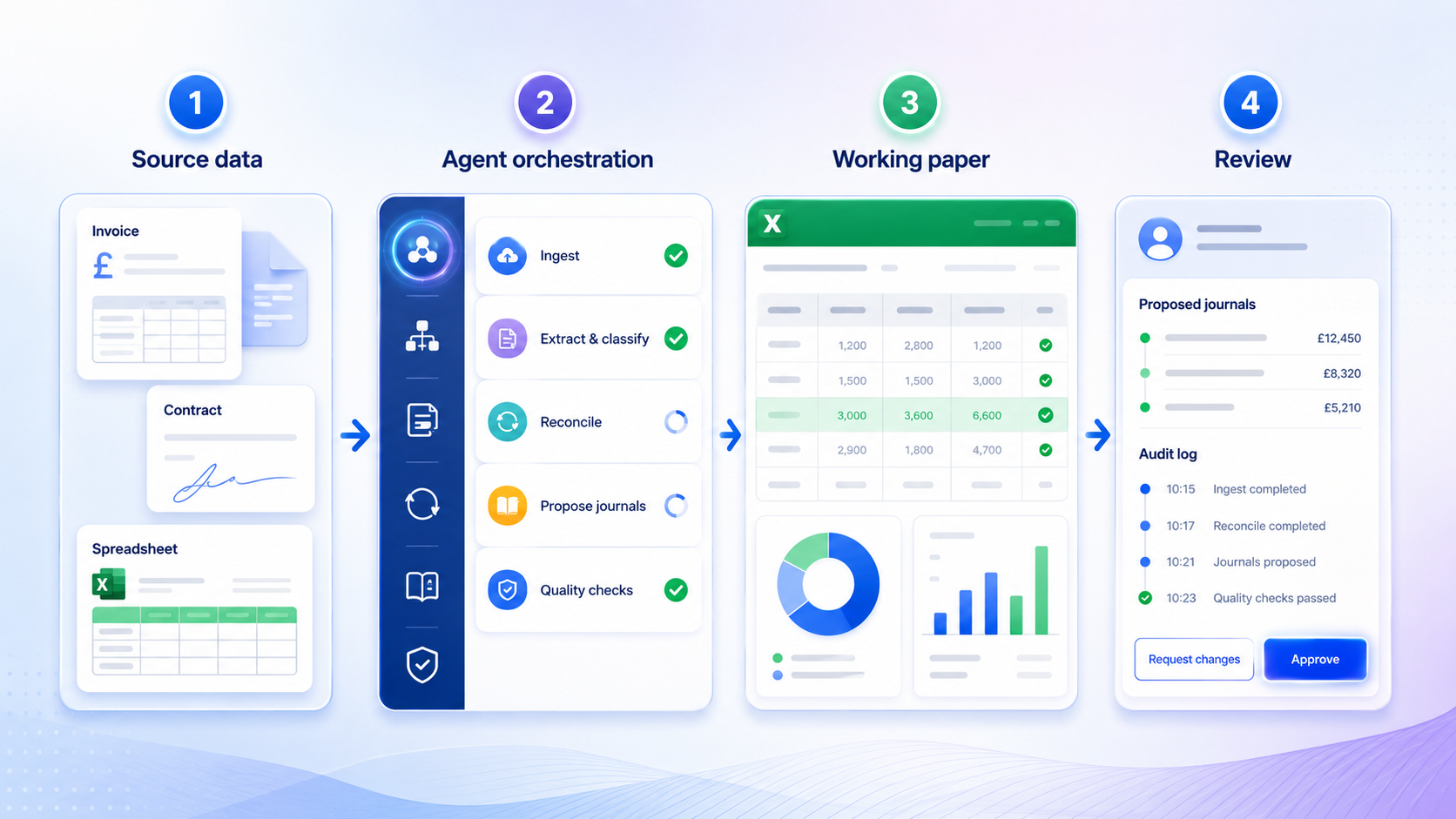
AI investment is accelerating, but the biggest opportunity isn’t helping individuals work faster. It’s helping entire firms operate better.

Every week seems to bring a new AI model, assistant, feature ad nauseam and lots of companies have spent the past couple of years asking: "How do we use AI?"
Close management software has traditionally helped firms bring order to a demanding process. It standardises working papers, checklists and procedures, assigns responsibilities and gives teams a shared view of progress across a portfolio of clients.